
Presence statistics show how much of a desk booking someone was actually at the desk. The data comes from Humly Booking Device, which senses the small vibrations of someone working at the desk.
In this article
- What you need
- Turn on presence detection
- How presence is calculated
- Examples
- Check-in and presence
- Find presence in the exports
What you need
- Humly Booking Device on the desk. Only this device detects presence. Humly Room Display and sensors do not add presence statistics.
- Good contact with the desk. Mount the device under the desk with the desk mount, or place it on the desk top.
- A booking. Presence is only stored during bookings. Someone using a desk without a booking adds no presence data.
Presence detection works best for desks. Rooms and parking spaces rarely have the steady vibrations the device needs.
Before you turn it on
Presence statistics describe how people use their desks. Make sure your organization is comfortable with collecting this data.
Turn on presence detection
Presence detection is off by default.
- Sign in to Humly Control Panel as a Global Admin or Local Admin.
- Go to Resources, select Desk and open Desk settings.
- Select the desks, or filter by location, and select Edit Selected.
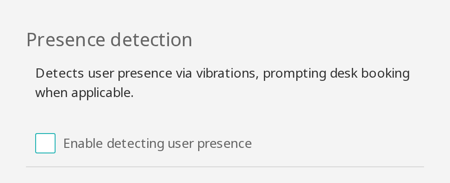
- Under Presence detection, select Enable detecting user presence.
- Select Save.
Presence detection does not run on desks set up as phone booths. With presence detection on, the device also asks people who sit down at a free desk whether they want to book it. See Humly Booking Device - Presence Detection.
How presence is calculated
- Presence starts when the device detects movement for about a minute during a booking.
- Presence ends 15 minutes after the device stops detecting movement. These 15 minutes still count as presence.
- Presence rate is the presence time as a share of the booking.
A booking with no movement at all gets 0 % presence.
Examples
Short booking. A user books a desk from 15:04 to 16:00 and leaves at 15:25 without coming back.
- Present from 15:04 to 15:25, plus 15 minutes until 15:40.
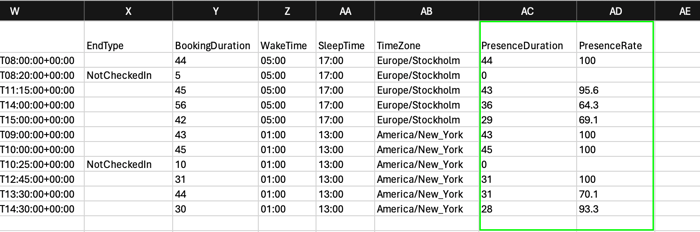
- Booking: 56 minutes. Presence: 36 minutes. Presence rate: 64.3 %.
Long booking. A user books a desk from 09:00 to 17:00, takes lunch from 12:00 to 13:00 and leaves at 16:30.
- Present from 09:00 to 12:15 and from 13:00 to 16:45.
- Booking: 8 hours. Presence: 7 hours. Presence rate: 87.5 %.
Short bookings give less precise rates, because the 15 minutes weigh more. Short breaks are a normal part of a working day.
Check-in and presence
Some desks require check-in for bookings made in Microsoft 365, Exchange, Google Workspace or Humly Reservations.
- Checked in: presence is counted from the start of the booking. Time before the start, for example when someone checks in early, is not counted.
- Not checked in: the booking ends, and its presence time is 0. No presence rate is calculated for it.
Find presence in the exports
Export from Statistics as described in Export statistics.
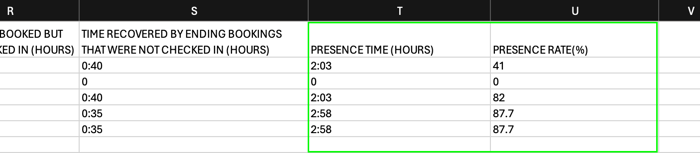
To CSV has two presence columns per location and desk: PRESENCE TIME (HOURS) and PRESENCE RATE(%).
Raw data to CSV has two presence columns per booking: PresenceDuration in minutes and PresenceRate in percent. A booking that was not checked in has a duration of 0 and an empty rate.
Statistics guide
Get started
Export and schedule
Reference
Settings that affect statistics
- Working hours in statistics
- Presence detection statistics
Help